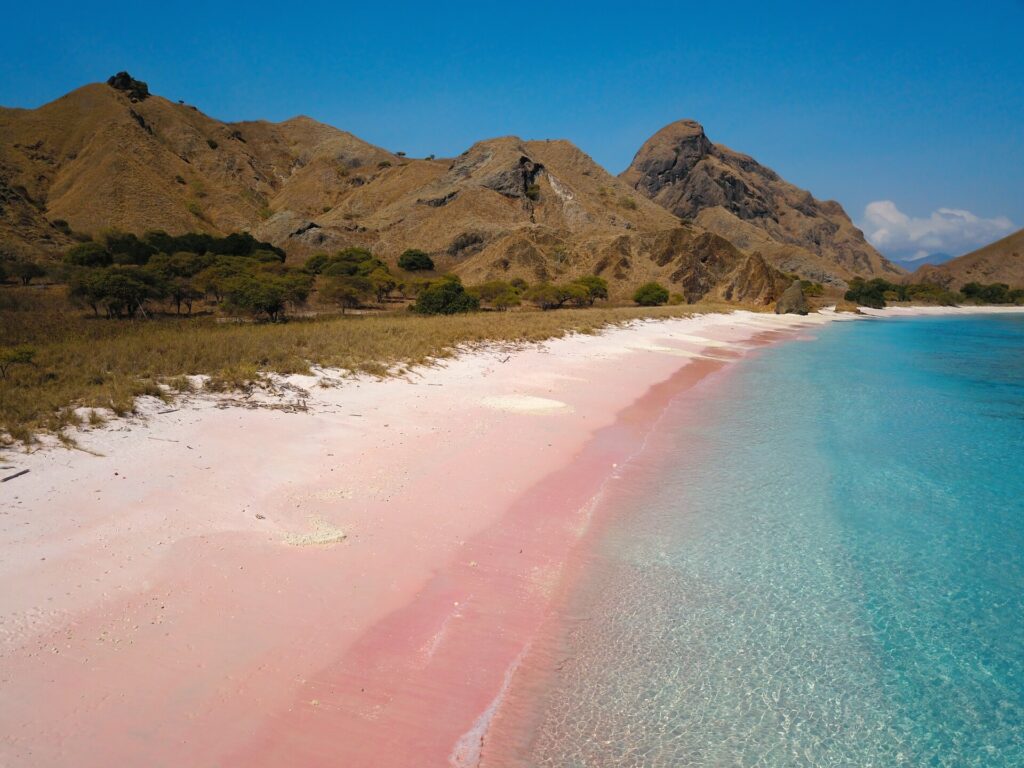
The Complete Field Guide to Pink Beach Komodo (Pantai Merah)
A 250-meter blush-pink shoreline on the southeastern coast of Komodo Island, inside Komodo National Park (UNESCO World Heritage Site). The most authoritative single-page guide on the internet — written by the team that has hosted 5,000+ Phinisi yacht guests at Pantai Merah since 2018.
Field Guide Contents
1. What and Where Is Pink Beach Komodo?
Pink Beach Komodo, locally known as Pantai Merah, is a small (~250 m × ~30 m) blush-pink-sand beach situated on the southeastern coast of Komodo Island. It lies within Komodo National Park — declared a UNESCO World Heritage Site in 1991 and one of Indonesia’s official “10 New Balis” priority destinations.
The beach is enclosed by a small bay, protected from open ocean swell, with a coral fringing reef beginning approximately 5 meters from the high-tide line. GPS coordinates: 8.5667° S, 119.4833° E. The nearest gateway city is Labuan Bajo on Flores, about 40 km west by sea.
2. The Origin of the Name “Pantai Merah”
“Pantai Merah” translates from Bahasa Indonesia as “Red Beach”. Local Manggarai-Komodo communities used the name long before mass tourism began, referring to the visibly red-pink wash visible at the waterline at low tide. International tour marketing in the 2000s rebranded it as “Pink Beach” — the term that now dominates English-language search.
3. Geographic & Geological Profile
| Attribute | Detail |
|---|---|
| Beach length | ~250 meters |
| Beach width (avg low tide) | ~30 meters |
| Bay orientation | East-southeast facing |
| Backshore terrain | Volcanic rocky hills, savannah grassland |
| Substrate composition | White carbonate sand + red Foraminifera shells + Tubipora musica coral fragments |
| Water depth at shore (high tide) | 0.5 – 1.5 m |
| Reef edge depth | 5–25 m drop-off |
Read the deep-dive on why Pink Beach is pink →
4. The Ecosystem (Marine + Terrestrial)
Marine: The reef supports 260+ coral species, 1,000+ reef fish species, 5 sea turtle species, reef whitetip and blacktip sharks, and seasonal manta rays at adjacent Manta Point. Visibility 15–30 m. Water temperature 26–29°C year-round.
Terrestrial: Behind the beach, savannah hills shelter Varanus komodoensis (Komodo dragons), Timor deer, wild boar, and over 70 bird species. Although Pink Beach itself is not a regular dragon trekking site, dragons occasionally pass through the back of the beach.
5. Cultural & Historical Significance
Komodo Island has been inhabited for over 2,000 years by the Ata Modo people, who developed a unique animist relationship with Komodo dragons (which they regard as ancestors). Pantai Merah was a traditional fishing landing point. International recognition came in 1980 with the founding of Komodo National Park, then UNESCO designation in 1991, and accelerated tourism after Komodo Airport (LBJ) expansion in 2015.
6. Conservation Status
Pink Beach is a fully protected marine zone within Komodo National Park. Removing sand, shells, or coral is a federal offense punishable under Indonesian Conservation Law (UU 5/1990). Tourist boat anchorage is restricted to designated mooring buoys. Drone permits and ranger escorts are required for all visits to the surrounding terrestrial trails.
7. The Visitor Experience: Hour-by-Hour
8. Park Regulations 2026
- Park entry fee: IDR 250,000 / person / day (marine ticket) + IDR 25,000 harbour fee
- Diving surcharge: IDR 25,000 per diver per day
- Drone permit: required, purchase in Labuan Bajo (not on the beach)
- No removal of sand, shells, coral, or living marine specimens
- Reef-safe sunscreen only (mineral-based: zinc oxide / titanium dioxide)
- No single-use plastic bags
- Ranger escort mandatory for all terrestrial trails
Full park fee breakdown 2026 →
9. Future Threats
Tourism pressure: Visitor numbers grew from ~40,000 (2010) to 220,000+ (2024). The 11:00–14:30 crowd window has visible impact on beach erosion patterns and coral reef stress.
Coral bleaching: The 2016 and 2024 El Niño events caused observable coral mortality at the southern reef edge. Foraminifera populations remain healthy but are sensitive to ocean acidification.
Climate: Rising sea levels are projected to reduce beach width by 15–25% by 2050 according to IPCC AR6 regional projections.
10. How to Visit Responsibly
- Visit outside the crowd window — book a Phinisi liveaboard so you’re there 06:30–08:30 or 15:30–17:00.
- Reef-safe sunscreen only — chemical sunscreen kills the very Foraminifera that make the beach pink.
- Take only photos. Removing pink sand is a federal offense and accelerates beach loss.
- Choose operators with proper permits — like Komodo Luxury, who pay full park concession fees.
- Limit your beach time — 1–2 hours is plenty. Don’t trample dune vegetation behind the beach.
Visit Pink Beach the Way It’s Meant to Be Experienced
Private Phinisi liveaboards from Komodo Luxury anchor overnight at Pink Beach so you wake up to a private pink shoreline.
See the Phinisi Fleet →